
Monday, October 8, 2012

Let's Work Together!


Hey everyone……..as you know school is back in and the BackPack Program is in full swing. Our volunteers are packing approximately 5000 sacks a week to go to children, in 33 counties, who are at risk of going hungry on weekends.  As of September 25, 2012 we have approx. 4200 of the 5000 children adopted but we still need your help to get these remaining 800 children adopted.
Get your co-workers together to chip in $5.00 or $10.00 each, get your Sunday school class involved, get the local schools involved. Let’s make sure all of these children get adopted. Let’s make sure that NO child goes hungry. With your help we can do this!!!!!!

-Angie Lile, Development Assistant

Tuesday, September 18, 2012

Choose a Child Here!


We have all seen the commercials that start out “For only 50 cents day you can help a child…” and they always tell you how poor the conditions are wherever that child is located. And it’s all true, but what we don’t realize is that we have children here in our own communities that are going to bed hungry every night.  I’m not saying don’t donate to those other countries where conditions really are appalling, just keep in mind that even though it’s not on the TV with a celebrity promoting it, we have hungry children here too.

Sometimes people respond better to numbers than words.  So let me share with you some numbers……….here at Feeding America, Kentucky’s Heartland we serve 42 counties, 33 of which participate in the BackPack Program. Our goal is to serve approximately 5,000 children on the BackPack Program for the 2012/2013 school year.  The cost to adopt a child on the BackPack Program for an entire school year is $100.00.  That equates to $2.50 a week or .50 cents a day ($2.50 divided by 5 days of school).  So, as the commercial says “For only .50 cents a day you can help a child…..” I hope you choose to help a child here.  

–Angie Lile, Development Assistant
Thursday, August 9, 2012

1 in 5 Children Go Hungry Here in the U.S.


Statistics tell us that 1 in 5 children go hungry here in the United States. This is a number that baffles some, amazes others, and angers most, but there is something we can all do to improve upon this number, we can give. We may not all be able to give financially but we can all find a way to give.

Every community has some way for us to give back, whether it is through the Family Resource Center at your local schools, local volunteer centers, or food pantries. I extend an invitation to everyone to give back to your community. You live there, work there, shop there, your children go to school there.

Take an hour or two to volunteer in your community once a week or once a month you have no idea how much such a small amount of your time can affect such a large amount of people for the better.  For more information on Volunteering, contact us at 270-735-1407.

Tuesday, July 17, 2012

Volunteers....A Gift to the Community


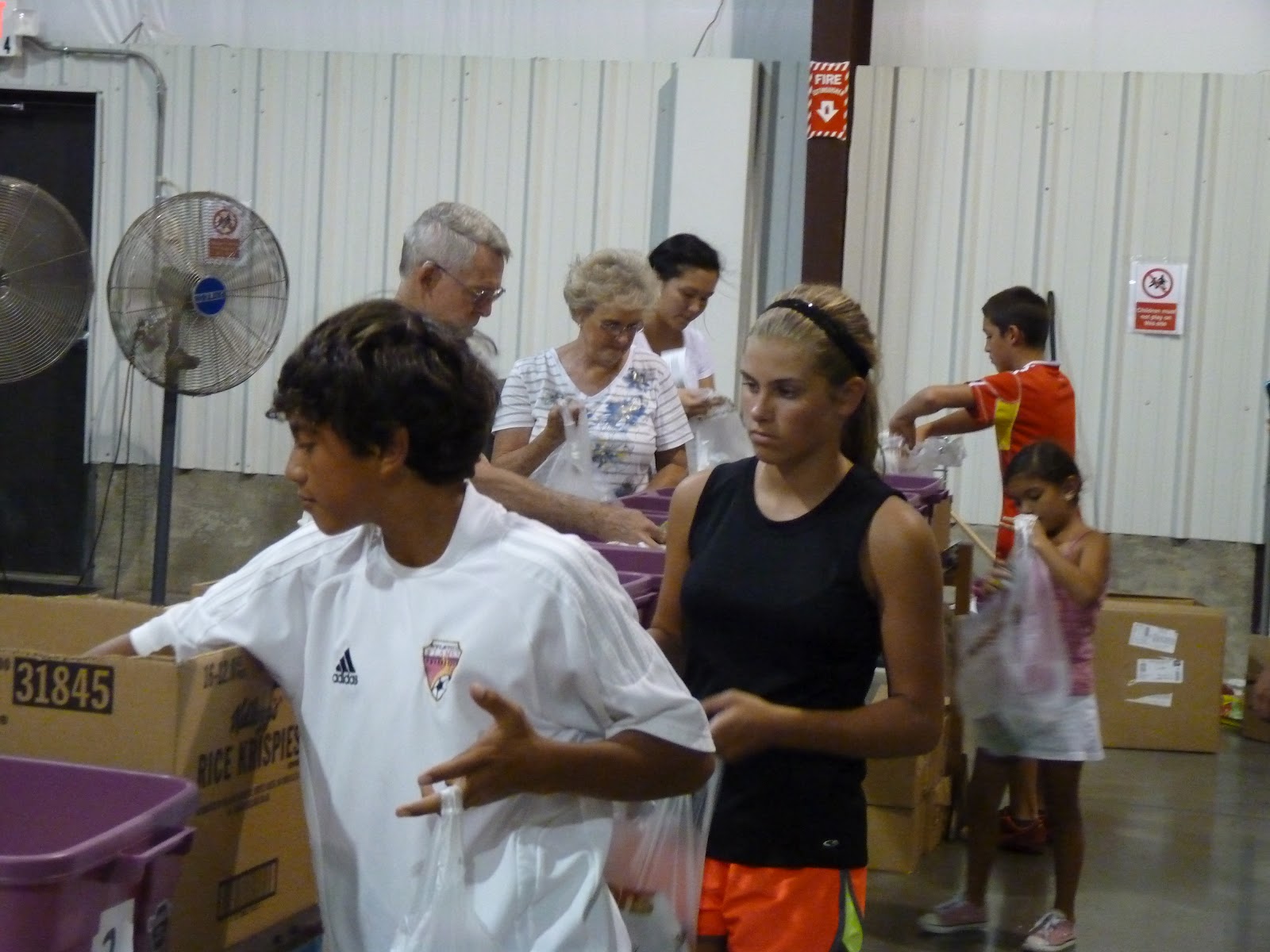
I have to admit that until coming to work for Feeding America, I had no idea the depth of what this organization does, who it helps or the number of people it helps. I had forgotten that there are still so many kind-hearted people out there willing to give up their personal time with friends and family to help complete strangers. 

The volunteers of Feeding America are more important than they could ever realize. They show up after working all day or going to school, they don’t let rain or heat stop them from showing up to help and they never ask for or expect kudos from anyone.  Well, to those unsung heroes, I say thank you. Thank you for making other people’s lives a little better, a little easier, a little more enjoyable. 

Our volunteers really are our heroes here at Feeding America.


Monday, April 16, 2012

Food Banks Fear They Will Fall Short in Efforts to Feed the Nation's Hungry


April 4, 2012


Higher food costs and rising gas prices could prove to be damaging to the nation's food banks and their ability to provide adequate emergency food to the nearly 49 million Americans who are currently living at risk of hunger, Feeding America, the network of the nation's largest food banks, announced.
Although recent reports indicate that the economy is beginning to improve and that the unemployment rate is also beginning to shrink, Feeding America's food banks continue to face significant struggles as America recovers from the worst economic recession in decades.
The Feeding America network of more than 200 food banks and 61,000 local partners are feeding 37 million Americans a year, including nearly 14 million children and 3 million seniors.  But with rising operating costs and decreasing supply, a number of factors are contributing to a "perfect storm" of challenges that threaten to leave food banks unable to meet the need in their communities.
Gas prices increased 26 percent in 2011, adding tremendous costs to transporting food. Increased fuel costs particularly affect rural areas, where populations are less dense. Many food banks support emergency feeding across a vast service area.
Food inflation is also hitting food banks hard. Grocery prices increased an average rate of 6 percent in the last half of 2011, and food banks have been hard pressed to make up the difference.
Feeding America Food banks have seen significant increases in the price of household staples like milk, which increased in price by nine percent in 2011, and peanut butter, which costs 38 percent more now than it did a year ago. Rising food prices also mean that healthy, nutritious food becomes further out of reach for many of the clients served by Feeding America, further increasing their reliance on food banks

Thursday, March 8, 2012

FARM BILL


The Hill, Farm Bill necessary for nation's food security
Americans enjoy the most abundant, safe and affordable food supply in the world. In fact, Americans spend less than 10 percent of their incomes on food -- the lowest in the world. Citizens in many other countries spend over 50 percent of their incomes on food.
Why is this? Certainly it's the hard work of American farmers and ranchers, new technology and wise stewardship of our natural resources. But a national farm policy that supports agriculture and provides a safety net for our farmers also plays a role. Agriculture policy has evolved over the years but its primary focus has endured: food security for our nation.
Serving on the House Agriculture Committee I see the benefits of ensuring a safe, adequate food supply for all Americans. We have seen the vulnerability to our country’s economy and high fuel prices due to our reliance on foreign energy. We must not make the same mistake with our food supply.